by admin | Oct 15, 2026 | Blog, Divorce, Divorce and Separation, Divorce Attorney, Divorce Debt, Divorce Lawyer, Family Property Act, Joint Credit Cards, Mortgage and Divorce, Property Division
When couples think about dividing property in a divorce, they usually picture the house, the vehicles and the retirement savings. But for many Alberta families, the bigger question is what happens to what they owe — the mortgage, the credit cards, the line of credit and the car loan.
With higher living costs and interest rates putting pressure on household budgets, debt is now one of the most contested issues we see. Understanding how debt is treated can save you thousands of dollars and protect your credit for years to come. Here is what our Divorce Lawyers in Edmonton want every separating spouse to know.
📞 Facing a divorce with shared debt? Call Kolinsky Law at +1 (780)-757-6400.
How Alberta Law Treats Debt in a Divorce
In Alberta, property division between married spouses and adult interdependent partners is governed by the Family Property Act. The general starting point is that property acquired during the relationship is shared equally — and debts are part of that calculation.
In practice, courts and lawyers look at the net value of family property: the total value of assets, minus the debts associated with them. Debts taken on during the relationship for family purposes are usually shared, regardless of whose name appears on the account.
🌐 Learn more about our divorce services: Visit our Divorce & Separation page
Common Types of Debt and How They Are Handled
- Mortgage on the family home: Usually deducted from the home’s value before equity is divided. One spouse may buy the other out, or the home may be sold and the mortgage paid off from the proceeds.
- Joint credit cards and lines of credit: Generally shared, especially when used for household expenses, groceries, childcare or family travel.
- Credit cards in one spouse’s name: Still often shared if the spending benefited the family. Spending solely for one person’s purposes may be treated differently.
- Car loans: Typically follow the vehicle — the spouse who keeps the car usually takes the loan with it.
- Student loans: Depends on timing and benefit. Loans from before the relationship are usually the borrower’s alone; loans during the relationship that increased family income may be treated differently.
- Tax debts: Income tax owing on income earned during the relationship can be a shared consideration, particularly where both spouses benefited from that income.
- Business debts: Often tied to the valuation of the business itself.
📝 Not sure how your debts will be divided? Fill out our contact form for a consultation.
Exempt Property, Pre-Relationship Debt and Unequal Division
Not every debt is split 50/50. Alberta law recognises situations where an equal division would be unfair:
- Debt brought into the relationship may remain the responsibility of the person who incurred it.
- Debts tied to exempt property — such as an inheritance or gift kept separate — may be treated along with that property.
- Reckless or secret spending, such as gambling losses or large purchases hidden from the other spouse, can justify an unequal division.
- Debt incurred after separation is generally the responsibility of the person who took it on, unless it was used to maintain family property or support the children.
Every case turns on its facts, which is why detailed records and early legal advice matter.
📧 Have questions about a specific debt? Email us at [email protected].
Why a Court Order Doesn’t Bind Your Lender
This is the point that surprises most people. A separation agreement or court order can say that your ex is responsible for a joint credit card or line of credit — but the lender is not a party to that agreement.
If your name is still on the account and your ex stops paying, the bank can pursue you for the full balance, and your credit score can suffer. That is why a good settlement goes further than simply assigning debts. It may:
- Require joint accounts to be closed or refinanced into one name by a set date
- Require a spouse keeping the home to qualify for the mortgage on their own
- Include indemnity terms, so you can recover money if you are forced to pay your ex’s share
- Adjust the property division to reflect who is carrying which debt
📞 Protect your credit before you sign anything — call +1 (780)-757-6400.
Practical Steps to Protect Yourself During Separation
- Pull your credit report from Equifax and TransUnion to see every account in your name.
- List all joint and individual debts with balances on the date of separation.
- Freeze or reduce limits on joint credit cards and lines of credit, where possible and appropriate.
- Keep paying minimums on joint accounts to protect your credit while the division is negotiated.
- Avoid new major debt until your financial issues are resolved.
- Exchange full financial disclosure — now required early under Alberta’s Family-Focused Protocol.
⭐ See how we’ve helped other Edmonton families — read our 5-star Google reviews.
How Kolinsky Law Can Help
At Kolinsky Law, our Divorce Lawyers in Edmonton help clients untangle shared finances fairly and permanently. We:
- Identify and value every asset and debt as of the separation date
- Argue for unequal division where spending was hidden, reckless or unfair
- Negotiate refinancing, buy-out and indemnity terms that protect your credit
- Draft enforceable separation agreements and consent orders
- Represent you in mediation, collaborative law or court under the Family-Focused Protocol
📝 Ready to talk to a lawyer? Contact our Edmonton divorce team.
About the Lawyer – David Kolinsky – Divorce Lawyer in Edmonton
Dividing debt is as much a numbers exercise as a legal one, and David Kolinsky approaches it that way. As the lawyer who founded Kolinsky Law and still leads its practice, he helps clients work through mortgage balances, credit card statements and lines of credit so every liability is valued at the separation date and shared fairly under the Family Property Act. Born and raised in Edmonton, David earned his Juris Doctor at the University of Toronto, began his career in Ontario in 2005 and has practised in Alberta since 2013. Because he is a member of the Bar in two provinces, Alberta and Ontario, and has litigated at trial and appellate levels, the settlements he negotiates are built to last, including the refinancing and indemnity terms that protect a client’s credit long after the divorce is final.
🌐 Learn more about our firm at kolinsky.ca.
Frequently Asked Questions
Q1. Am I responsible for my spouse’s credit card debt after divorce in Alberta?
A1. If the card is only in your spouse’s name, the lender cannot pursue you. However, the debt may still be considered when dividing family property if it was used for family expenses.
Q2. Are debts split 50/50 in an Alberta divorce?
A2. Debts incurred during the relationship for family purposes are generally shared equally as part of the net value of family property, but courts can order an unequal division where equal sharing would be unfair.
Q3. What happens to the mortgage when we divorce?
A3. The mortgage is usually deducted from the home’s value. One spouse may refinance and buy out the other, or the home may be sold and the mortgage paid from the proceeds.
Q4. Can my ex’s debt hurt my credit score after divorce?
A4. Yes, if your name remains on a joint account. Lenders are not bound by your separation agreement, so joint accounts should be closed or refinanced as part of your settlement.
Q5. Who pays debt taken on after separation?
A5. Generally, the spouse who took on the debt after separation is responsible for it, unless it was used to preserve family property or support the children.
Q6. Is student loan debt divided in a divorce?
A6. Student loans from before the relationship usually stay with the borrower. Loans taken during the relationship are assessed based on when they were incurred and whether the family benefited.
Q7. Do I need a divorce lawyer in Edmonton to divide debt?
A7. A lawyer helps ensure every debt is properly valued, argues for fair treatment of hidden or reckless spending, and builds refinancing and indemnity terms into your agreement so your credit is protected.
📧 Still have questions? Email [email protected] — we’re happy to help.
Don’t Let Shared Debt Follow You Out of Your Marriage
Dividing debt fairly — and making sure that division actually protects you — is one of the most important parts of any divorce. With the right plan, you can leave your marriage with a clean financial slate.
📞 Speak with an experienced Edmonton divorce lawyer today: +1 (780)-757-6400.
Your financial future deserves careful, strategic advice — let Kolinsky Law, home to some of the Best Divorce Lawyers in Edmonton, Alberta, guide you through it.
#EdmontonDivorceLawyer #DivorceAlberta #DivorceDebt #FamilyPropertyAct #AlbertaFamilyLaw #DivideDebtDivorce #MortgageAndDivorce #CreditAfterDivorce #FinancialDivorce #SeparationAlberta #KolinskyLaw #YEGLaw #YEG #BestDivorceLawyerEdmonton #DivorceFinances #MoneyAndDivorce #FamilyLawyerEdmonton #DivorceTips #FreshStart #KnowYourRights
by admin | Aug 25, 2026 | Blog, Divorce, Divorce and Separation, Divorce Attorney, Divorce Lawyer
Building a business is hard enough on its own. Building one while also raising a family, paying a mortgage, and trying to keep a marriage healthy? That’s a whole different level of juggling. So when a marriage involving a family business starts to fall apart, one question tends to keep both spouses up at night: what happens to the business now?
It’s rarely a simple split down the middle. A business isn’t like a bank account or a car — its value can be argued, its ownership can be tangled up with other people, and its future often depends on the very person who’s now going through a divorce. If you’re a business owner in Alberta facing separation, or married to one, understanding how valuation and division actually work can save you from costly surprises later.
Worried about what a divorce means for your business? Speak with a Best Divorce Lawyer Edmonton trusts today. Call +1 (780)-757-6400.
Is a Family Business Considered Matrimonial Property in Alberta?
In most cases, yes. Under Alberta’s Family Property Act, a business started or grown during the marriage is generally treated as matrimonial property, regardless of whose name is on the incorporation documents. It doesn’t matter if only one spouse worked in the business day-to-day — if it was built or increased in value during the relationship, the other spouse likely has a financial claim to a share of that growth.
There are exceptions. A business owned before the marriage, or one that was inherited or gifted, may be partially excluded from division. But “partially” is the key word — any increase in value during the marriage is usually still shared, even if the original asset itself isn’t.
Not sure if your business counts as matrimonial property? Get a straight answer from Divorce Edmonton’s trusted legal team. Book a consultation.
How Do Courts Determine the Value of a Business?
This is where things get technical fast. Courts don’t just look at what the business made last year — they want a fair, defensible number that reflects the company’s true worth. That typically means bringing in a business valuator, often a Chartered Business Valuator (CBV), to prepare an independent report.
Valuators generally rely on one or more of these approaches:
- Income-based approach – looking at projected future earnings and cash flow
- Market-based approach – comparing the business to similar companies that have recently sold
- Asset-based approach – calculating the net value of everything the business owns, minus liabilities
The right method depends on the type of business. A dental practice with steady, predictable income is valued very differently than a construction company with fluctuating contracts, or a family retail store with significant physical assets.
Need an accurate business valuation for your divorce? Our team works with trusted experts to protect your interests. Email [email protected] for guidance.
What Factors Can Complicate a Business Valuation?
Not every business valuation is straightforward, and a few common issues tend to come up again and again in Alberta cases:
- Goodwill – how much of the business’s value depends on the owner’s personal reputation, relationships, or skill, versus the business itself
- Co-ownership – when other partners, family members, or shareholders are involved, and only one spouse’s share is up for division
- Reinvested profits – businesses that pay owners a modest salary while reinvesting most profits back into the company, which can understate true financial benefit
- Non-arm’s-length transactions – payments to family members or related companies that may need closer scrutiny
These complications are exactly why a “quick estimate” from an accountant isn’t usually enough for court purposes. A defensible valuation needs to hold up under cross-examination if the matter becomes contested.
Complicated business structure? A Divorce Lawyer in Edmonton can help untangle it. Call +1 (780)-757-6400 today.
How Is the Business Actually Divided?
Here’s something many spouses don’t expect: dividing a business doesn’t necessarily mean splitting ownership or forcing a sale. In fact, courts and family lawyers generally try to avoid disrupting an operating business, especially if it’s the household’s main source of income.
Common approaches include:
- Buyout – the spouse who runs the business pays the other spouse their share of the value, often using other matrimonial assets (like the house or investments) as an offset
- Structured payments – if there isn’t enough liquidity for a lump sum, payments can be spread over time
- Co-ownership – less common, but sometimes former spouses continue as business partners, particularly if the relationship allows for it
- Sale of the business – used as a last resort, typically when neither spouse can afford a buyout and no other arrangement works
The right path depends heavily on the couple’s overall financial picture, not just the business alone.
Trying to figure out your options? Talk to a Best Divorce Lawyer Edmonton couples recommend. Fill out our contact form.
Does It Matter If Only One Spouse Worked in the Business?
Many business owners assume that because their spouse never set foot in the office, they shouldn’t have any claim to it. Alberta law sees it differently. Matrimonial property division isn’t about who physically built the business — it’s about recognizing both spouses’ contributions to the marriage as a whole, including a spouse who managed the household, raised children, or supported the other’s career in less visible ways.
That said, the specific role each spouse played can still influence negotiations around buyout structure, timelines, and how the business is treated going forward.
Wondering how your role — or your spouse’s role — affects the outcome? Get clear answers from Divorce Edmonton’s family law team. Call +1 (780)-757-6400.
Can a Prenuptial or Cohabitation Agreement Protect the Business?
Yes, and this is one of the most effective tools available. A well-drafted marriage agreement (prenup) or cohabitation agreement can define, ahead of time, how a business will be treated if the relationship ends — including whether it’s excluded from division, how it will be valued, and what happens to future growth.
Without one, spouses are left relying on Alberta’s default property division rules, which don’t always align with what a business owner had in mind when they started their company.
Thinking ahead to protect your business? Learn about marriage agreements with our Edmonton family law team.
Why Professional Legal Guidance Matters So Much Here
Business division cases tend to be some of the most contested and emotionally charged parts of a divorce, and understandably so. There’s often a lot riding on the outcome: employees who depend on the business, a family’s main source of income, and years of work that one or both spouses poured themselves into.
Having experienced legal representation isn’t just about protecting the number on a valuation report — it’s about protecting the future of something you built. Working with one of the Best Divorce Lawyers in Edmonton Alberta ensures your interests are represented clearly, whether you’re the business owner or the spouse seeking a fair share.
Don’t navigate a business division alone. Speak with the Best Divorce Lawyers Edmonton residents trust. Read our clients’ 5-star reviews here.
Final Thoughts
A family business adds real complexity to divorce, but it doesn’t have to mean a messy, drawn-out battle. With the right valuation approach and a clear understanding of Alberta’s property division rules, most business owners and their spouses can reach an outcome that’s fair, practical, and protects what matters most — including the business’s ability to keep running.
Ready to protect your business and your future? Visit Kolinsky Law or call +1 (780)-757-6400 to book your consultation.
Frequently Asked Questions
1. Is my spouse entitled to part of my business if they never worked in it?
Yes, in most cases. Alberta law focuses on contributions to the marriage as a whole, not just direct involvement in the business. If the business grew during the marriage, your spouse likely has a claim to a share of that growth, even if they never worked a single day there.
2. How much does a business valuation cost in a divorce?
Costs vary depending on the size and complexity of the business, but a professional valuation from a Chartered Business Valuator typically ranges from a few thousand dollars to significantly more for larger or more complicated businesses. It’s an investment that protects both spouses from an unfair outcome.
3. Will I be forced to sell my business in a divorce?
Not necessarily. Courts generally prefer solutions like buyouts or offsetting the business’s value against other assets (such as the family home) rather than forcing a sale, especially if the business is a primary source of income.
4. Can a business owned before marriage still be divided?
The original value of a business owned before marriage may be excluded from division, but any increase in its value during the marriage is typically still shared between spouses.
5. What’s the difference between a business valuation for divorce and one for selling the business?
A divorce valuation focuses on determining fair value for property division purposes under Alberta family law, often factoring in goodwill and future earning potential differently than a valuation prepared for an actual sale or acquisition.
6. Do I need a lawyer if my divorce involves a business?
Strongly recommended. Business division cases involve financial complexity, valuation disputes, and negotiation strategy that go well beyond a standard property split. Experienced legal guidance helps protect both the business and your long-term financial interests.
About the Edmonton Divorce Lawyer – David Kolinsky
David Kolinsky is a respected Divorce Lawyer in Edmonton, known for his practical, client-focused approach to complex family law matters, including business and matrimonial property division. With years of experience guiding Alberta families and business owners through separation, David brings both legal precision and genuine care to every case he handles.
How We Can Help: At Kolinsky Law, we work closely with business valuators, accountants, and financial experts to build a strong, evidence-based case for your business division matter. Whether you’re negotiating a buyout, protecting a family enterprise, or seeking your fair share of a company’s growth, our team is here to guide you through every step with clarity and confidence.
Contact Kolinsky Law today — call +1 (780)-757-6400, email [email protected], or book your consultation online.
#DivorceLawyerEdmonton #BusinessDivorce #FamilyBusinessDivision #AlbertaFamilyLaw #DivorceEdmonton #MatrimonialProperty #BusinessValuation #EdmontonLawyer #DivorceLawyerAlberta #PropertyDivision #FamilyLawAlberta #KolinskyLaw #DavidKolinsky #DivorceAdvice #SmallBusinessOwners #PrenuptialAgreement #AlbertaDivorce #BestDivorceLawyerEdmonton

by admin | Aug 14, 2026 | Divorce, Divorce and Separation, Divorce Attorney, Divorce Lawyer
If you and your partner have called it quits but you’re still under the same roof, you’re not alone — and you’re not doing it wrong. Rent and mortgages in Edmonton aren’t cheap, kids don’t care whose name is on the lease, and moving out the day a relationship ends just isn’t realistic for most people. The good news: Alberta law doesn’t require you to move out to be legally separated physically. But there’s a right way and a wrong way to handle it, and getting it wrong can cost you later.
What “Separated” Actually Means Under the Law
A lot of people assume separation means separate addresses. It doesn’t. Under the Divorce Act, what matters is whether you’re living “separate and apart” — and Canadian courts have long recognised that two people can do that under one roof. The date you started living separate and apart is still what starts your one-year separation clock toward divorce, even if you never left the house.
Wondering if your situation qualifies as separated? Call Kolinsky Law at +1 (780) 757-6400.
Why So Many Couples Live Together After Separating
This isn’t a rare or unusual arrangement — it’s increasingly the norm. The most common reasons we hear:
- Neither person can afford to carry the household alone right away
- Keeping kids in the same home, school, and routine during a hard transition
- Waiting for the house to sell before splitting into two households
- One or both partners aren’t ready to explain a move to family, friends, or coworkers yet
None of these reasons weakens your legal position — but how you conduct yourselves during that time matters a lot.
Need to plan a separation that works for your household? Explore our Divorce and Separation services or email [email protected].
How You Prove You’re Separated If You Still Share an Address
This is where things get real. If your separation date is ever disputed — and it sometimes is, especially where support or property division is involved — the court will look at your actual conduct, not just what you say. Judges typically weigh factors like:
- Sleeping in separate bedrooms
- No longer presenting as a couple socially or to family
- Dividing household responsibilities separately rather than functioning as one unit
- Having told at least one other person (family, friend, accountant) that the relationship is over
- Filing taxes as separated once the date has passed
- No ongoing joint financial planning as a couple
You don’t need every single factor to check out, but the more of your day-to-day life actually reflects “separated,” the stronger your position if the date ever gets questioned.
Not sure your situation would hold up if challenged? Visit our contact page or call +1 (780) 757-6400.
What This Means for Divorce, Support, and Property
Your separation date isn’t just a technicality — it affects real outcomes. It’s typically the cutoff used for valuing and dividing matrimonial property; it starts the clock on the one-year separation period required for most divorces, and it can matter for calculating support. Getting the date wrong, or having no way to support it, can create real disputes later — especially if one party later claims the relationship continued longer than the other believes.
Want your separation date properly documented and protected? Call +1 (780) 757-6400.
Protecting Yourself While You’re Still Living Together
If you’re staying under one roof for practical reasons, a few things go a long way:
- Put your separation in writing to each other, even informally, and keep a copy
- Start keeping finances separate where possible — separate accounts, no new joint debt
- Agree on a rough plan for parenting time and household division of labour, even before it’s formalised
- Talk to a lawyer early rather than waiting until you’ve physically moved out to “make it official”
A separation agreement can be signed and dated while you’re still living together — it doesn’t require separate addresses to be valid, and it can make the eventual move far less complicated.
Thinking about formalising things while you’re still under one roof? Visit Kolinsky Law or call +1 (780) 757-6400 — we’ll help you get it right from day one.
Frequently Asked Questions
Q: Can you be legally separated while still living in the same house in Alberta?
A: Yes. Alberta and federal divorce law recognise that couples can live “separate and apart” under the same roof, based on factors such as separate bedrooms, separate finances, and no longer functioning as a couple.
Q: Does my separation date still count if we never physically moved into different homes?
A: Yes, as long as your day-to-day conduct reflects an actual separation. The date is based on when you began living separate and apart in practice, not when one person moved out.
Q: What proof do I need if my ex disputes our separation date later?
A: Courts look at evidence such as separate sleeping arrangements, divided household finances, having told others the relationship ended, and separate tax filings once the date has passed.
Q: Can we sign a separation agreement while still living together?
A: Yes. A separation agreement is valid whether or not you share an address, and putting one in place early can make an eventual move much simpler.
Q: Does living together after separating affect child support or spousal support?
A: It can, depending on how finances and parenting responsibilities are actually being handled during that time, which is why documenting your arrangement clearly matters.
About the Best Divorce Lawyer in Edmonton — David Kolinsky
David Kolinsky has guided countless Edmonton couples through exactly this situation — still sharing a home, still co-parenting under one roof, while genuinely separated in every way that matters legally. As founder of Kolinsky Law, David understands that real life doesn’t always match the tidy version of separation people expect, and he helps clients document their situation properly so their separation date, support entitlements, and property division hold up no matter how the living arrangement looks from the outside. Serving Edmonton, Sherwood Park, St. Albert, Spruce Grove, and Leduc. Reach out at +1 (780) 757-6400 or [email protected] to talk through your specific situation.
#AlbertaFamilyLaw #SeparatedNotDivorced #EdmontonDivorceLawyer #StillLivingTogether #DivorceAlberta #KolinskyLaw #SeparationAgreement #CoParenting #EdmontonFamilyLawyer #DivorceHelp #DavidKolinsky
by admin | Jul 19, 2026 | Blog, Child Custody, Child Custody Lawyer, Family Attorney, Family Law Lawyer, Family Lawyer
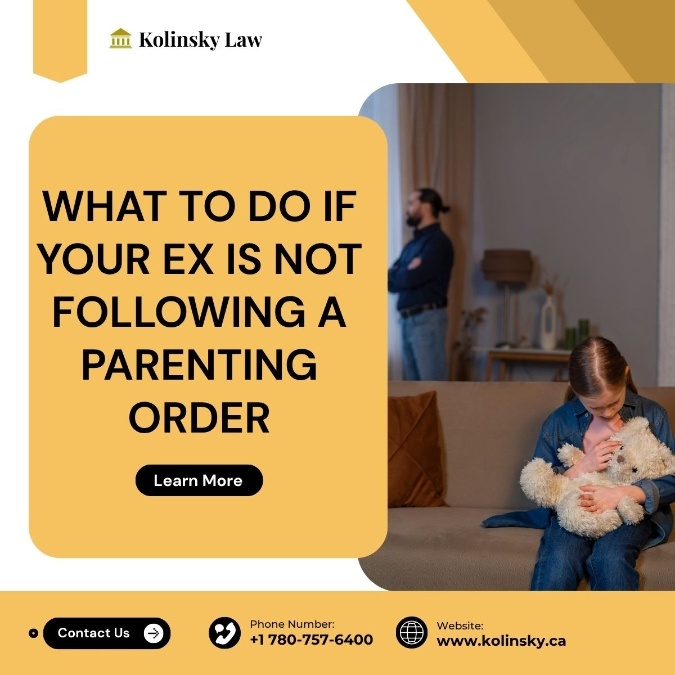
Parenting orders are legally binding court orders that establish parenting time, decision-making responsibilities, and other arrangements concerning children after a separation or divorce. These orders are intended to provide stability for children and clarity for parents. However, disputes can arise when one parent repeatedly fails to comply with the terms of the order.
A parent’s failure to comply with a parenting order can create significant challenges. Knowing your legal options under Alberta law can help you address the situation effectively while protecting your child’s best interests.
📞 Need immediate guidance? Call the Best Family Lawyer in Edmonton at +1 (780)-757-6400.
Confirm the Nature of the Violation
Not every disagreement amounts to a breach of a parenting order. Before taking legal action, carefully review the order and identify how it is being violated. Common issues include denying parenting time, repeatedly returning a child late, refusing to share important information about the child, or making major decisions without the required consent of the other parent.
Understanding the specific terms of the order is essential because enforcement measures typically depend on the nature and severity of the violation.
📩 Unsure if it’s a breach? Ask Edmonton’s Top Child Custody Lawyer — email [email protected] today.
Keep Detailed Records
Documentation can play a critical role if the dispute escalates. Parents should keep records of missed parenting exchanges, cancelled visits, unanswered communications, and any other incidents involving non-compliance.
Written communication such as emails, text messages, and parenting app records may help demonstrate a pattern of behaviour. Maintaining accurate records can provide valuable evidence in the event of a court dispute and assist a Child Custody Lawyer Edmonton Alberta families rely on in building a strong case.
📝 Start building your case the right way — visit our Child Custody Page.
Attempt to Resolve the Issue
In some situations, non-compliance may result from misunderstandings, scheduling conflicts, or communication breakdowns rather than intentional misconduct. Before pursuing formal legal remedies, it may be worthwhile to address the issue directly with the other parent calmly and professionally.
A respectful discussion can sometimes resolve the problem and prevent unnecessary conflict. However, parents should avoid confrontational behaviour or actions that could worsen the situation or negatively affect the child.
💬 Not sure how to approach the conversation? Get advice from the Best Lawyer for Child Custody in Edmonton.
Consider Mediation or Alternative Dispute Resolution
When communication becomes difficult, mediation or other forms of dispute resolution may help parents reach practical solutions without returning to court. A neutral third party can facilitate discussions and assist both parents in identifying workable arrangements.
Alternative dispute resolution can often preserve co-parenting relationships while reducing the emotional and financial costs associated with litigation.
🤝 Explore mediation options with a Family Lawyer in Edmonton — call +1 (780)-757-6400.
Seeking Court Enforcement
If informal efforts fail and the violations continue, court enforcement may be necessary. Alberta courts have the authority to enforce parenting orders and address repeated non-compliance.
Depending on the circumstances, the court may order makeup parenting time, require participation in parenting programs, impose conditions on future parenting arrangements, or take other measures designed to encourage compliance. In serious cases, ongoing violations may influence future decisions regarding parenting responsibilities.
Courts generally focus on what is in the child’s best interests rather than punishing either parent. As a result, any enforcement action will typically be evaluated through that lens.
⚖️ Ready to pursue enforcement? Speak with the Best Child Custody Lawyer Edmonton parents trust.
Avoid Taking Matters Into Your Own Hands
When a parenting order is being ignored, it can be tempting to respond by withholding parenting time or refusing to comply with your own obligations. However, taking unilateral action may create additional legal complications and could negatively affect your position before the court.
Parents should continue following the terms of the order whenever possible while pursuing appropriate legal remedies. Seeking guidance from experienced Family Lawyers Edmonton families trust can help ensure that your response remains legally sound.
🛑 Don’t risk your case — get sound legal advice first. Request a callback.
When to Seek Legal Advice
Repeated violations of a parenting order can place significant strain on both parents and children. Legal advice may be particularly important when non-compliance becomes frequent, affects the child’s well-being, or involves serious concerns regarding safety or decision-making authority.
At Kolinsky Law, we help parents understand their rights, evaluate enforcement options, and take appropriate legal action when parenting orders are not being respected. Addressing violations promptly can help preserve stability for children and reduce the risk of more serious disputes in the future.
📌 Protect your child’s future — visit https://kolinsky.ca/ or call +1 (780)-757-6400 today.
FAQs
Q1. What should I do if my ex is not following our parenting order in Alberta?
A1. Start by confirming whether the behaviour is actually a violation of the order’s specific terms, then keep detailed records of every incident. Try resolving the issue directly or through mediation before pursuing court enforcement. If violations continue, consult the Best Child Custody Lawyer Edmonton offers to discuss enforcement options.
Q2. Can I withhold parenting time if my ex violates the order?
A2. No. Taking unilateral action, such as withholding parenting time, can create legal complications and may weaken your position in court. Continue following the order while pursuing appropriate legal remedies through a Family Lawyer in Edmonton.
Q3. What counts as a violation of a parenting order?
A3. Common violations include denying scheduled parenting time, repeatedly returning a child late, withholding important information about the child, or making major decisions without the other parent’s required consent.
Q4. What evidence do I need to prove my ex is violating the parenting order?
A4. Keep records of missed exchanges, cancelled visits, unanswered messages, and any related written communication, including emails, texts, and parenting app logs. This documentation helps demonstrate a pattern of non-compliance if the matter goes to court.
Q5. Will the court punish my ex for violating the parenting order?
A5. Alberta courts focus primarily on the child’s best interests rather than punishing a parent. However, enforcement measures may include makeup parenting time, mandatory parenting programs, or conditions on future arrangements, and repeated violations can influence future custody decisions.
Q6. When should I hire a lawyer for parenting order violations?
A6. You should seek legal advice when non-compliance becomes frequent, affects your child’s well-being, or raises safety or decision-making concerns. Edmonton’s Top Child Custody Lawyer, David Kolinsky, can help you evaluate your options and take appropriate legal action.
Q7. How can Kolinsky Law help with parenting order enforcement?
A7. Kolinsky Law helps parents confirm violations, gather evidence, pursue mediation, and file for court enforcement when necessary. Contact the Best Lawyer for Child Custody in Edmonton at +1 (780)-757-6400 or [email protected] to discuss your case.
⭐ Read our clients’ 5-star reviews.
About Edmonton’s Top Child Custody Lawyer — David Kolinsky
David Kolinsky is widely regarded as the Best Child Custody Lawyer Edmonton families turn to when parenting disputes become complicated. With extensive experience handling parenting order violations, enforcement applications, and complex custody matters, David and the team at Kolinsky Law are committed to protecting children’s best interests while guiding parents through every stage of the legal process.
Whether you need help confirming a breach, gathering evidence, pursuing mediation, or filing for court enforcement, Kolinsky Law offers clear, compassionate, and strategic legal support. As the Best Family Lawyer in Edmonton, David Kolinsky works closely with each client to build a tailored plan that safeguards both their parental rights and their child’s well-being.
📞 Call: +1 (780)-757-6400 | 📩 Email: [email protected] | 📝 Contact Us: https://kolinsky.ca/contact/
#ParentingOrder #ChildCustodyEdmonton #FamilyLawEdmonton #CoParenting #CustodyLawyerEdmonton #EdmontonFamilyLawyer #ParentingTimeDispute #AlbertaFamilyLaw #ChildCustodyLawyer #KolinskyLaw #DavidKolinsky #FamilyLawAlberta #DivorceLawEdmonton #CourtEnforcement #ChildrensBestInterests
by admin | Jul 18, 2026 | Best Lawyer for Family Disputes, Blog, Divorce and Separation, Divorce Attorney, Divorce Lawyer, Family Divorce Lawyer, Family Law Lawyer
When couples divorce, the division of assets often extends beyond homes, bank accounts, and personal property. Retirement savings, including Registered Retirement Savings Plans (RRSPs) and pension benefits, can represent some of the most valuable assets accumulated during a marriage. Because these assets are intended to provide financial security later in life, understanding how they are treated during divorce is essential.
In Alberta, RRSPs and pensions may form part of the property division process. However, the way these assets are valued and divided depends on several factors, including when they were acquired, their current value, and the specific circumstances of the relationship.
👉 Speak with a trusted Family Divorce Lawyer Edmonton team — call +1 (780)-757-6400 today.
Are RRSPs Considered Family Property?
RRSPs are generally considered property that may be subject to division upon separation or divorce. Amounts contributed to an RRSP during the relationship, together with any appreciation in value, may form part of the assets subject to division.
However, not every dollar held in an RRSP is necessarily divisible. Contributions made before the relationship began may be treated differently, particularly if sufficient documentation exists to establish their value at the outset. Identifying the portion of an RRSP that may be divided typically requires a thorough examination of financial records.
👉 Unsure if your RRSP counts as family property? Get clarity from our Divorce Lawyer Edmonton team.
How Are RRSPs Divided?
The value of an RRSP is typically determined as of a specific date, often the date of separation. Once the value has been established, it may be included in the overall property division calculations.
In some situations, one spouse may retain the RRSP while the other receives an offsetting share of different assets. In other cases, a direct transfer between RRSP accounts may occur. Proper structuring is important because certain transfers can be completed without immediate tax consequences if legal requirements are met.
👉 Need help structuring a tax-smart RRSP transfer? Email us at [email protected].
Understanding Pension Division
Among all marital assets, pensions can be some of the most challenging to value and divide. Unlike RRSPs, pension plans often require specialized calculations to determine their value.
A pension earned during the relationship may be subject to division even if retirement is years away. Depending on the type of pension plan, actuarial assessments may be necessary to calculate the portion accumulated during the marriage and its present value.
Given the long-term value of pension benefits, it is essential to ensure they are properly assessed before finalising any agreement.
👉 Protect your pension rights with experienced Edmonton Divorce Lawyers — book a consultation.
Defined Benefit vs. Defined Contribution Plans
Not all pensions operate in the same way. Defined contribution plans are generally based on the contributions made to the account and the investment growth earned over time. Their value is often easier to determine because an account balance exists.
Defined benefit plans can be more challenging to value because future pension payments are based on variables such as income history and years of employment. As a result, professional valuation is often necessary.
👉 Have a defined benefit or contribution plan? Talk to a Family Lawyer in Edmonton — call +1 (780)-757-6400.
Factors That Can Affect Division
Several factors may influence how RRSPs and pensions are addressed during a divorce. These include the length of the relationship, the timing of contributions, pre-relationship assets, existing agreements between spouses, and the overall property division framework.
Accurate financial disclosure is critical. Failing to identify or properly value retirement assets can result in disputes and potentially unfair outcomes. Individuals should ensure that all relevant financial information is available before negotiating a settlement.
👉 Ensure full and fair financial disclosure — visit kolinsky.ca to learn how we can help.
Why Professional Guidance Matters
Retirement assets often represent years or even decades of savings. Errors in valuing or dividing these assets can have lasting financial consequences long after a divorce is finalized.
At Kolinsky Law, we help clients understand how RRSPs, pensions, and other financial assets may be treated during separation and divorce. As experienced Family Lawyers Edmonton families rely on, we work to ensure that retirement assets are properly identified, valued, and addressed during property division negotiations.
For individuals facing complex financial issues, seeking advice from a Divorce Attorney in Edmonton can help clarify rights, obligations, and available options. Understanding how RRSPs and pensions are treated under Alberta law is an important step toward achieving a fair and informed resolution.
👉 See why clients trust us — read our 5-star reviews on Google.
FAQs
Q1: Are RRSPs split 50/50 in a divorce in Alberta?
A1. Not automatically. RRSP contributions and growth accumulated during the relationship are generally subject to division, but the exact split depends on factors like when contributions were made, existing agreements, and overall property division calculations — not a fixed 50/50 rule.
Q2: Do I have to pay tax if my RRSP is divided in a divorce?
A2. Direct transfers between spouses’ RRSP accounts can often be completed without immediate tax consequences, provided legal and CRA requirements are properly met. Improperly structured transfers can trigger unexpected tax liability.
Q3: Can my spouse claim part of my pension if we divorce?
A3. Yes. A pension earned during the relationship may be divisible even if retirement is years away. The divisible portion is typically calculated through valuation or actuarial assessment based on the years accumulated during the marriage.
Q4: What’s the difference between dividing a defined benefit and a defined contribution pension?
A4. Defined contribution plans are usually easier to value since they have a clear account balance. Defined benefit plans require professional actuarial valuation because future payouts depend on factors like income history and years of service.
Q5: What happens to RRSP contributions made before marriage?
A5. Contributions made before the relationship began may be treated differently and excluded from division, provided there is sufficient documentation to establish their value at the start of the relationship.
Q6: Why should I hire a divorce lawyer to handle RRSP and pension division?
A6. Retirement assets can be complex to value and are often subject to strict legal and tax rules. A knowledgeable Divorce Lawyer Edmonton can ensure accurate valuation, proper financial disclosure, and a fair division that protects your long-term financial security.
About the Divorce Attorney Edmonton – David Kolinsky
David Kolinsky is a dedicated Divorce Attorney in Edmonton and the founder of Kolinsky Law, with extensive experience helping individuals and families navigate the financial and emotional complexities of separation and divorce. As a trusted Family Divorce Lawyer Edmonton clients turn to, David and his team bring a practical, detail-oriented approach to even the most complex property division matters, including the valuation and division of RRSPs, pensions, and other retirement assets.
How we can help: Whether you need a Family Lawyer in Edmonton to guide you through a separation agreement or a Divorce Lawyer Edmonton to represent your interests in court, our team works to protect what matters most — your financial future, your family, and your peace of mind. We provide clear, personalized advice at every stage, from initial financial disclosure through to final settlement, ensuring your retirement assets are properly identified, valued, and fairly divided.
📞 Call us today at +1 (780)-757-6400 or contact us online to schedule a consultation.
#DivorceLawyerEdmonton #FamilyLawyerEdmonton #EdmontonDivorceLawyers #FamilyDivorceLawyerEdmonton #RRSPDivorce #PensionDivision #AlbertaFamilyLaw #DivorceAttorneyEdmonton #DivorceAdvice #KolinskyLaw #PropertyDivision #DivorceFinance #FamilyLawAlberta #SeparationAdvice #EdmontonLawyers #DavidKolinsky