
by admin | Feb 27, 2026 | Best Criminal Lawyer, Blog, DUI, Impaired Driving Lawyers
Understanding the Terminology in Canadian Law
Many people use the terms DUI and impaired driving interchangeably, but there is an important legal distinction in Canada. Unlike some other countries, Canadian law does not officially use the term DUI. Instead, the Criminal Code defines the offence as impaired driving. Despite this, DUI remains a widely used term in everyday conversation to describe operating a vehicle under the influence of alcohol or drugs.
Understanding the difference between common language and legal terminology helps people better recognise how charges are actually classified.
If you’re unsure how your charge is classified, speak directly with a DUI Lawyer Edmonton today at +1 (780)-757-6400.
What Impaired Driving Means in Canada
Impaired driving in Canada refers to operating a motor vehicle while your ability to drive is affected by alcohol, drugs, or a combination of both. This includes having a blood alcohol concentration over the legal limit or showing visible signs that your control, coordination, or judgment is reduced. Impairment can result from alcohol, cannabis, prescription medication, or illegal substances.
The law focuses on whether the driver’s ability to operate a vehicle safely was impacted at the time, not just the presence of a substance in the body.
Charged with impaired driving? Contact our Impaired Driving Lawyers Edmonton at or call +1 (780)-757-6400 for immediate legal guidance.
Why the Term DUI Is Still Common
Although DUI is not a formal legal term in Canada, it is still widely recognised due to media influence and international usage. Many people use it when discussing charges related to drinking and driving, even though Canadian courts and legislation refer specifically to impaired driving offences. This difference in terminology can confuse those trying to understand what they may be charged with.
In legal discussions handled by a Criminal Lawyer Edmonton, the correct charge is always based on impaired driving laws under the Criminal Code.
Get clarity on your specific charge—consult our experienced Impaired/DUI Lawyers Edmonton today.
Types of Impaired Driving Offences
Canadian law outlines several forms of impaired driving offences. These include driving while impaired by alcohol, driving while impaired by drugs, and driving with a blood alcohol level over the legal limit. There are also offences related to refusing to provide a breath sample when requested by law enforcement. Each type of charge is treated seriously and can result in criminal penalties.
The specific circumstances of the incident, such as the level of impairment and whether there was any harm caused, can affect the severity of the outcome.
Facing alcohol or drug-related charges? Call +1 (780)-757-6400 to speak with a trusted DUI Lawyer Edmonton now.
Legal Consequences and Long-Term Impact
The consequences of an impaired driving conviction in Canada can be significant. Penalties may include fines, licence suspension, mandatory driving prohibitions, and possible jail time, especially in repeat cases. A conviction can also result in a permanent criminal record, which may affect employment opportunities, travel, and insurance rates.
Legal professionals, including the Best DUI Lawyers in Edmonton, often focus on reviewing the details of how evidence was collected and whether proper legal procedures were followed during the investigation.
Protect your record and your future—schedule a confidential consultation or email [email protected] today.
Alcohol and Drug Impairment Differences
Both alcohol and drug impairment fall under the same legal framework, but the way they are assessed can differ. Alcohol-related cases often rely on breathalyzer results and blood alcohol concentration levels. Drug-related impairment may involve field sobriety tests, blood samples, or other evaluations. Regardless of the substance involved, the key factor remains whether the driver’s ability to operate the vehicle safely was affected.
This is why every case is assessed based on evidence and observed behaviour at the time of the incident.
Speak with experienced Impaired Driving Lawyers Edmonton who understand both alcohol and drug cases—call +1 (780)-757-6400 now.
Why the Legal Distinction Matters
Understanding the difference between DUI and impaired driving is important because only impaired driving is recognised as an offence under Canadian law. While the term DUI may be used informally, it does not appear in the Criminal Code. Knowing the correct legal definition helps individuals better understand the nature of the charge and the legal process that may follow. Anyone facing such allegations should be aware of the seriousness of the offence and the potential consequences under Canadian law.
Don’t navigate impaired driving charges alone—consult a leading DUI Lawyer Edmonton today.
About the Best Lawyer for Impaired Driving Charges in Edmonton – David Kolinsky
When facing impaired driving allegations, having experienced legal representation can make a critical difference. David Kolinsky at Kolinsky Law is recognised as one of the Most Trusted Criminal Defence Lawyers in Edmonton, with extensive experience defending clients against impaired driving and DUI-related charges.
Our firm carefully examines every detail of your case, including roadside procedures, breath or blood testing accuracy, Charter rights compliance, and evidentiary issues. We build strong, strategic defences tailored to your specific circumstances to protect your rights, freedom, and future.
Call +1 (780)-757-6400 | Email [email protected] | book a confidential consultation | Read our clients’ 5-star reviews.
#DUILawyerEdmonton #ImpairedDrivingLawyersEdmonton #ImpairedDrivingCanada #CriminalDefenceLawyer #EdmontonLawyer #DUICharges #DrinkAndDriveLaw #AlbertaLaw #CriminalCodeCanada #KnowYourRights #LegalHelpEdmonton #DavidKolinsky #KolinskyLaw

by admin | Jan 21, 2026 | Child Custody, Child Custody Lawyer, Divorce, Divorce and Separation, Divorce Attorney, Divorce Lawyer
High-conflict divorce is not a legal label but a practical reality frequently encountered in family courts. These cases are marked by persistent hostility, repeated applications, poor communication, and an inability to resolve even minor parenting issues. Alberta courts recognise that prolonged parental conflict can be more damaging to children than separation itself.
As a result, judges focus less on assigning blame between parents and more on limiting a child’s exposure to ongoing disputes. At Kolinsky Law, we see that court responses in high-conflict cases are grounded in experience, evidence, and child-focused risk management.
Facing a complex divorce? Secure your child’s future. Call Kolinsky Law at +1 (780)-757-6400.
How Courts Identify High-Conflict Cases
Courts identify high-conflict dynamics through patterns rather than isolated incidents. Repeated emergency motions, allegations that shift over time, refusal to comply with orders, and communication that escalates rather than resolves issues all signal concern. Judges also review how parents involve children in disputes, including disparaging comments or pressure to take sides. The Best Divorce Lawyer Edmonton often advises clients that conduct during litigation is closely monitored, as it directly informs how the court structures future parenting arrangements.
Your conduct in court matters. Let an Edmonton Divorce Lawyer guide you strategically.
The Central Role of the Child’s Best Interests
In high-conflict matters, the child’s best interests are assessed through a harm-reduction lens. Courts ask whether ongoing parental interaction places the child at emotional or psychological risk. Stability, predictability, and emotional safety take precedence over parental preferences. Judges are less concerned with equal parenting time and more focused on whether the child can maintain healthy relationships without being drawn into conflict.
Prioritise your child’s emotional safety. Consult our Child Custody Lawyer in Edmonton today.
Court-Ordered Parenting Structures
To reduce exposure to conflict, courts frequently impose structured parenting regimes. These may include parallel parenting orders, which limit direct communication and assign clear decision-making authority. Exchanges may be restricted to neutral locations or supervised settings. Detailed schedules reduce ambiguity and opportunities for dispute. Edmonton’s Top Child Custody Lawyer understands that these orders are not punitive but practical tools developed through years of judicial experience with high-conflict families.
Need clarity on parenting orders? Explore our resources.
Limits on Communication and Decision-Making
Courts often regulate how parents communicate. Orders may require the use of parenting apps, written-only communication, or strict boundaries around topics of discussion. In extreme cases, one parent may be granted sole decision-making authority for education or medical care to prevent stalemates. Judges assess whether shared decision-making is workable; if not, they prioritise efficiency and the child’s well-being over formal equality.
Struggling with co-parenting communication? We can help. Email us at [email protected].
Use of Professionals and Court Resources
In high-conflict cases, courts regularly rely on third-party professionals. Parenting assessors, child psychologists, and family justice counsellors provide insight into family dynamics and child impact. These professionals do not replace the court’s role but assist judges in understanding risk and crafting effective orders. Where appropriate, courts may order parenting coordination to manage ongoing disputes outside the courtroom.
Complex case needing expert input? Let’s discuss your situation. Contact us via our form.
Enforcement and Consequences for Non-Compliance
When conflict persists despite clear orders, courts turn to enforcement. Repeated non-compliance can result in reduced parenting time, cost consequences, or, in rare cases, contempt findings. Courts are particularly firm when behaviour undermines a child’s relationship with the other parent. Divorce Lawyer in Edmonton frequently cautions that ongoing defiance of court orders is viewed as evidence of poor judgment, not commitment to the child.
Concerned about order enforcement? Protect your rights. Call +1 (780)-757-6400 now.
Why Courts Avoid Endless Litigation
Judges are acutely aware that prolonged litigation fuels conflict. Courts increasingly seek finality by issuing comprehensive, long-term orders rather than incremental adjustments. This approach limits repeated court involvement and provides children with consistency. The objective is not to resolve parental conflict, but to contain it so children can develop outside the dispute.
Seek a final, stable order for your child. Read our 5-star reviews and see why clients trust us.
Conclusion
High-conflict divorce requires courts to act decisively and pragmatically. Alberta judges rely on observed behaviour, professional input, and enforceable structures to protect children from ongoing parental disputes. The legal system’s response is shaped by real-world experience, with the child’s stability as the guiding principle. At Kolinsky Law, we approach these cases with a clear understanding of how courts move from conflict management to child protection, ensuring decisions are rooted in reality rather than theory.
Ready for pragmatic legal support? Start with a consultation: Click to fill the form.
About David Kolinsky – Best Child Custody and Divorce Lawyer in Edmonton
David Kolinsky is a dedicated family law advocate focused on navigating high-conflict divorce and custody cases in Edmonton. With a deep understanding of how Alberta courts prioritise child protection, David provides strategic, evidence-based representation designed to reduce conflict and secure stable, enforceable parenting arrangements. He leverages judicial trends and professional resources to shield children from parental disputes, ensuring your case is built on practical legal experience, not just theory. Whether you need a skilled negotiator or a strong courtroom advocate, David Kolinsky can help you navigate this challenging process with clarity and purpose.
#FamilyLaw #CanadianFamilyLaw #AlbertaFamilyLaw #LegalAdvice #LawyerLife #CoParenting #SharedParenting #ChildAdvocacy #ChildrensRights #ParentalAlienation #HealthyCoParenting #EdmontonFamilyLawyer #AlbertaLaw #ChildCustodyLawyer #DivorceLawyer #LegalHelpEdmonton #ConflictResolution #ParallelParenting #CourtOrder #ParentingPlan #BestInterestOfTheChild #StructuredParenting #Litigation #KolinskyLaw #DavidKolinsky #EdmontonExpert #TrustedLawyer
by admin | Jan 21, 2026 | Child Custody, Child Custody Lawyer, Divorce, Divorce and Separation, Divorce Attorney, Divorce Lawyer, Family Attorney, Family Divorce Lawyer, Family Lawyer
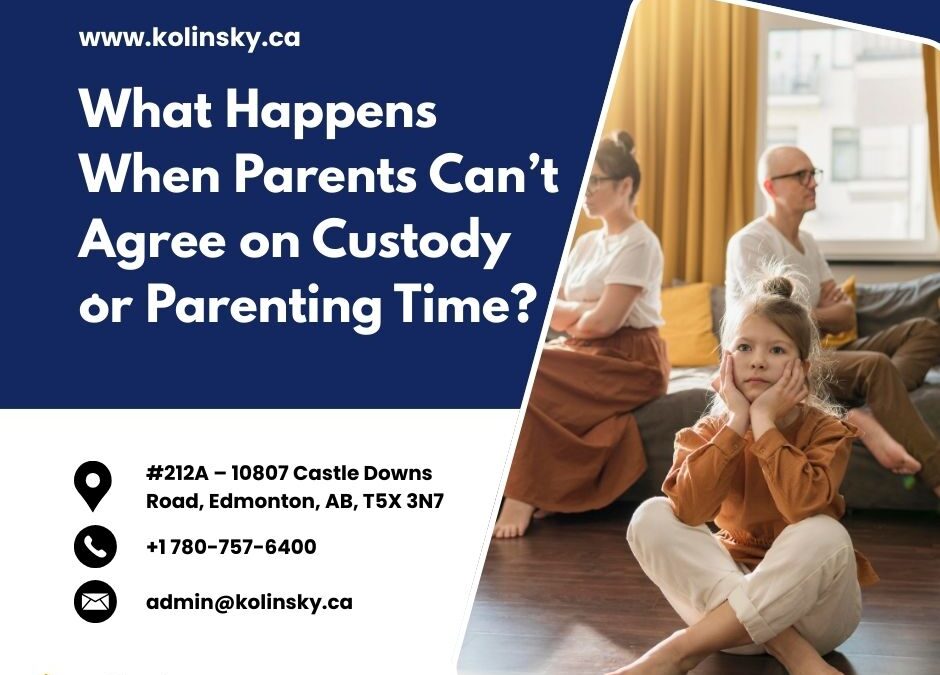
When parents can’t agree on custody or parenting time after separation is one of the most common reasons family matters end up in court. These disputes are rarely about legal terminology and more often about control, fear, or mistrust. Alberta courts are well aware that unresolved conflict between parents can place children in the middle of adult disputes. When agreement cannot be reached, courts step in with a structured, evidence-based process designed to reach workable parenting arrangements that prioritise the child’s wellbeing over parental preferences.
Concerned about a custody dispute? Speak directly with a Divorce Lawyer Edmonton at +1 (780)-757-6400.
Initial Expectations of the Court
Courts expect parents to make reasonable efforts to resolve parenting disputes before litigation escalates. Judges routinely ask whether parties attempted negotiation, mediation, or family justice services. A failure to engage constructively can influence how a judge later views credibility and cooperation. That said, when communication has broken down or power imbalances exist, courts do not delay intervention simply to force agreement. A Divorce Lawyer Edmonton will often advise that the court’s role is not to compel harmony, but to impose structure where cooperation is no longer realistic.
Need guidance on court expectations? Let’s discuss your case: [email protected].
Temporary Orders While the Case Proceeds
When parents cannot agree, courts often issue interim parenting orders. These are temporary arrangements designed to provide stability while the case moves forward. Judges rely on existing routines, caregiving history, and immediate practical needs rather than long-term ideals. Interim orders are not predictions of outcomes, but they can shape momentum. Courts closely observe how parents comply with these orders, as behaviour during this stage can influence final decisions.
Need help with a temporary order? Contact our Edmonton Divorce Lawyers today.
How Courts Decide Parenting Arrangements
Final parenting decisions are guided by the child’s best interests under Alberta law. Courts assess factors such as the child’s age, emotional needs, the child’s relationship with each parent, and the child’s exposure to conflict. Judges also examine each parent’s ability to support the child’s relationship with the other parent. Equal parenting time is not presumed. Where cooperation is low, courts prioritise stability, predictability, and emotional safety over symmetry.
Learn how courts decide custody here: Child Custody Lawyer.
Evidence That Carries Weight
Courts rely heavily on objective evidence when parents disagree. This includes school records, medical information, communication logs, and third-party observations. Allegations without supporting proof are treated cautiously. Judges are particularly attentive to patterns of behaviour rather than isolated incidents. A Child Custody Lawyer Edmonton understands that demonstrating consistency, reliability, and child-focused decision-making is often more persuasive than emotional testimony.
Build a strong, evidence-based case. Schedule a consultation now.
Role of Parenting Assessments and Professionals
In contested cases, courts may order parenting assessments or involve neutral professionals. These experts evaluate family dynamics, parenting capacity, and the child’s needs. Their reports often carry significant influence, especially when parents provide conflicting narratives. Courts also use family justice counsellors or parenting coordinators to reduce disputes and assist with the implementation of orders. These tools reflect the court’s practical approach to managing disagreement rather than relying solely on courtroom advocacy.
Facing a parenting assessment? Get expert legal support. Call +1 (780)-757-6400.
Limits on Parental Decision-Making
When parents cannot agree on major decisions, courts may assign decision-making responsibility to one parent in specific areas such as education or healthcare. This does not reflect a judgment of worth, but a recognition that deadlock harms children. Shared decision-making is only ordered when evidence indicates that parents can communicate effectively without ongoing conflict.
Stuck in a decision-making deadlock? We can help clarify your options. Reach us now.
Consequences of Ongoing Conflict
Persistent refusal to cooperate can have legal consequences. Courts may adjust parenting time, impose detailed schedules, or restrict communication methods. In extreme cases, cost awards or enforcement measures may follow. Edmonton Divorce Lawyers frequently remind clients that courts focus on conduct over intention; repeated conflict is viewed as a risk factor for children, regardless of motive.
Avoid negative legal consequences. Seek experienced counsel today.
Conclusion
When parents cannot agree on custody or parenting time, courts intervene with structured, child-focused solutions. Decisions are based on evidence, observed behaviour, and the practical need to reduce conflict. At Kolinsky Law, we guide clients through this process with a clear understanding of how courts resolve disagreements—by prioritising stability, minimising harm, and ensuring parenting arrangements reflect reality, not ongoing disputes.
Ready for a resolution? Complete our contact form to book your consultation.
About David Kolinsky – Best Divorce and Child Custody Lawyer in Edmonton
David Kolinsky is a dedicated Family Lawyer in Edmonton with a focused practice on divorce and child custody matters. He understands that parenting disputes are emotionally charged and strives to provide clear, strategic guidance aimed at protecting your children’s well-being and your parental rights. At Kolinsky Law, we help you navigate the court process with confidence, from interim orders to final arrangements, ensuring your case is presented effectively. We are committed to pursuing solutions that offer stability and peace of mind for your family’s future.
How we can help: We provide expert legal representation in contested custody cases, helping you understand court expectations, gather compelling evidence, and advocate for a parenting arrangement that serves your child’s best interests. Let us turn a stressful conflict into a structured path forward.
See why clients trust us: Read our 5-star Google Reviews.
#CustodyBattle #ParentingTime #SharedParenting #CoParenting #FathersRights #MothersRights #VisitationRights #ParentalAlienation #FamilyCourt #ContestedCustody #InterimOrders #ParentingAssessment #EvidenceInCourt #LegalStrategy #TemporaryOrders #HighConflictDivorce #SeparatedParents #ProtectYourKids #ChildWellbeing #FamilyConflict #PeacefulParenting #DivorceSupport #KolinskyLaw #DavidKolinsky #FamilyLawyer #LegalExpertise #TrustedAdvisor
by admin | Dec 23, 2025 | Blog, Child Support, Child Support Lawyers
Child support is designed to ensure that a child’s financial needs continue to be met after parents separate or divorce. In Alberta, child support is not automatically fixed for the entire duration of a child’s upbringing. The law recognises that financial circumstances, parenting arrangements, and a child’s needs can change over time.
For this reason, existing child support arrangements may be reviewed and adjusted when specific legal conditions are met. Understanding when changes are permitted, what qualifies as a valid reason, and how the process works helps parents comply with Alberta family law and avoid unnecessary disputes.
Facing a change in circumstances? Speak directly with our Edmonton child support lawyers today at +1 (780)-757-6400 for clear guidance.
Yes, Child Support Can Be Changed
Under Alberta law, child support can be changed after divorce if there has been a material change in circumstances since the original amount was established. This applies whether child support was set through a court order or a written agreement between parents. The focus is not on personal dissatisfaction with the current amount, but on whether circumstances affecting the child or the parents’ ability to contribute financially have changed in a meaningful and lasting way.
Unsure if your situation qualifies as a material change? Contact our Edmonton child support team via email at [email protected] for a confidential assessment.
What Is Considered a Material Change
A material change is a significant development that could not reasonably have been anticipated when child support was originally determined. Common examples include a substantial increase or decrease in income, job loss, long-term illness, disability, or retirement. Changes in parenting arrangements, such as a child spending significantly more time with one parent, may also qualify. As a Child Support Lawyer Edmonton, parents often consult, and we explain that short-term income fluctuations or voluntary reductions in earnings generally do not meet the legal threshold.
Get a professional evaluation of your case. Visit our child support lawyer page to understand your options.
Income Changes and Support Adjustments
Child support in Alberta is primarily calculated using the Federal Child Support Guidelines, which are largely income-based. If a paying parent’s income changes significantly, either parent may request a recalculation of child support. This applies when income increases as well as when it decreases. Full and accurate financial disclosure is required.
Courts treat non-disclosure seriously and may draw negative conclusions or impose consequences if income information is withheld. In some cases, courts may adjust child support retroactively where a parent delayed addressing a known income change, resulting in arrears.
Ensure full compliance and protection. Let our experienced lawyers handle your support variation. Schedule a consultation through our contact form here.
Changes Based on the Child’s Needs
A child’s needs often evolve as they grow. Increased educational costs, medical expenses, or participation in extracurricular activities may justify a review of child support. These costs are commonly addressed as special or extraordinary expenses, often referred to as section 7 expenses. Courts consider whether these expenses are reasonable, necessary, and consistent with the family’s circumstances, as well as how they should be shared between parents based on income and financial capacity.
See why clients trust us with complex child support matters. Read our 5-star client reviews on Google here.
Agreements Versus Court Orders
When child support is set by agreement, parents sometimes assume they can change the amount informally. While parents may agree to a different arrangement, informal changes may not be legally enforceable. Proper documentation and, where appropriate, court filings are strongly recommended. If child support was established by court order, a formal application is required to vary it. A Best Lawyer for Child Support in Edmonton can help determine the correct process and ensure that any changes comply with legal requirements.
Don’t risk an unenforceable agreement. Secure your child’s financial future. Call us at +1 (780)-757-6400.
Shared Parenting and Support Changes
In shared parenting arrangements, where a child spends at least 40 percent of their time with each parent, child support is calculated differently. If parenting time changes enough to meet or fall below this threshold, it may justify a reassessment of support. Courts focus on how parenting time is actually exercised in practice, not simply what is written in an agreement or order.
Need clarity on support in a shared parenting setup? Email [email protected] for strategic advice.
Why Legal Guidance Matters
Requests to change child support can become contentious, particularly when parents disagree about income, expenses, or parenting time. At Kolinsky Law, we help parents understand their rights and obligations under Alberta law while keeping the child’s best interests at the centre of the process.
Child support is meant to reflect current realities, not outdated circumstances. When meaningful changes occur, Alberta law allows support to be reviewed so it remains fair, accurate, and focused on the child’s well-being.
Navigate the variation process with confidence. Explore how we can help on our dedicated child support page.
About the Best Child Support Lawyer in Edmonton – David Kolinsky
At Kolinsky Law, founder David Kolinsky and his team are dedicated to providing expert legal guidance on child support matters in Edmonton. We understand that financial and familial circumstances evolve, and we are here to help you navigate the legal process of reviewing, modifying, or enforcing child support orders. Our approach is tailored to your unique situation, ensuring compliance with Alberta law while prioritising your child’s best interests and your family’s stability. From assessing material changes and calculating accurate support amounts to handling complex negotiations and court applications, our firm is committed to securing fair and sustainable outcomes. If you believe a change in child support is warranted, contact us to ensure your case is managed with precision, care, and a deep understanding of family law.
Ready to address your child support changes with a top-rated Edmonton lawyer? Contact Kolinsky Law today through our secure online form to book your consultation.
#ChildSupport #EdmontonLawyer #AlbertaDivorce #FamilyLaw #DivorceLawyer #CoParenting #ChildSupportModification #AlbertaFamilyLaw #EdmontonLegal #KolinskyLaw #FathersRights #MothersRights #SharedParenting #Section7Expenses #MaterialChange

by admin | Dec 23, 2025 | Blog, Spousal Support, Spousal Support Lawyer
Spousal support often creates uncertainty after separation or divorce, particularly when circumstances change over time. Many people believe that once spousal support is ordered or agreed upon, it must continue exactly as set, regardless of what happens later. In Alberta, that assumption is incorrect. Spousal support is based on current financial realities, not fixed expectations.
When circumstances change in a significant and lasting way, Alberta family law allows spousal support to be reviewed, varied, or terminated early. Understanding how this process works helps both paying and receiving spouses assess their rights and obligations realistically.
Unsure if your situation qualifies as a material change? Consult with our experienced Spousal Support Lawyer in Edmonton for a clear assessment.
Is Early Termination of Spousal Support Allowed?
Yes, spousal support can be terminated early in Alberta, but it is not automatic. A court will only consider ending support if there has been a material change in circumstances since the original order or agreement was made. The purpose of spousal support is to address economic imbalance and assist adjustment after the relationship ends, not to provide permanent income where the original rationale no longer exists. Each case is assessed on its specific facts rather than on a fixed timeline.
Need to discuss your case specifics? Contact Kolinsky Law today at +1 (780)-757-6400.
What Is Considered a Material Change?
A material change is a significant development that could not reasonably have been anticipated at the time spousal support was established. Common examples include the recipient obtaining stable employment, achieving financial independence, or experiencing a substantial increase in income. A serious decline in the payor’s income, long-term illness, disability, or retirement may also qualify.
As a Spousal Support Lawyer in Edmonton, clients often consult me. We emphasise that the change must be meaningful and ongoing, not temporary or self-imposed.
Confused about what constitutes a material change? Let our team guide you. Reach out via our contact form.
Does Remarriage or Cohabitation End Support?
Remarriage does not automatically terminate spousal support in Alberta. However, it can strongly support a request for variation or termination if it reduces the recipient’s financial need. Cohabitation may also be relevant, particularly when a new partner contributes to shared living expenses. Courts focus on the economic impact of the new relationship rather than its legal status. If financial dependence has decreased, continued support may no longer be appropriate.
Has your ex-spouse’s relationship status changed? Get strategic advice from a leading Spousal Support Lawyer in Edmonton.
Self-Sufficiency and the Purpose of Support
One objective of spousal support is to encourage financial independence where possible. If the recipient has had a reasonable time and opportunity to become self-supporting, continued payments may no longer be justified. Courts examine education, work history, age, health, and the length of the relationship. Where support was intended to be transitional, evidence that self-sufficiency has been achieved can support early termination. This issue is frequently addressed by a Spousal Support Lawyer in Edmonton when reviewing long-term support arrangements.
Wondering if self-sufficiency arguments apply to you? Email us at [email protected] for insights.
Agreements Versus Court Orders
How spousal support was created matters. If support is set out in a separation agreement, the wording of that agreement is critical. Some agreements allow review or variation, while others restrict changes unless specific conditions are met. Courts are generally reluctant to override negotiated agreements, particularly where both parties had independent legal advice. If spousal support was established by court order, a formal application is required to vary or terminate it.
Need to review your agreement or order? Visit our dedicated spousal support page to learn how we can help.
Role of the Spousal Support Advisory Guidelines
The Spousal Support Advisory Guidelines are not legally binding, but courts rely on them to assess appropriate duration and amount. They help evaluate whether ongoing support remains reasonable based on income changes and relationship length. A situation that now falls outside guideline ranges may support termination.
Concerned about guideline calculations? Secure knowledgeable legal support from our Edmonton firm.
Why Legal Guidance Matters
Spousal support variation applications can become complex and emotionally charged. At Kolinsky Law, we help clients assess whether circumstances meet the legal threshold and how to present evidence clearly.
Spousal support in Alberta is not meant to continue once its purpose has been fulfilled. When circumstances change meaningfully, the law allows support to end so outcomes remain fair and grounded in present realities.
Ready to explore your options? Read our client’s 5-star reviews on our GMB page to see why we’re trusted.
About the Best Spousal Support Lawyers in Edmonton – David Kolinsky
Navigating a spousal support variation or termination requires a precise understanding of Alberta family law and persuasive advocacy. At Kolinsky Law, David Kolinsky and his team provide focused and strategic legal guidance tailored to your unique situation. We help you thoroughly assess material changes, interpret complex agreements, and build a compelling court case, always aiming to achieve a fair and financially sensible resolution. If you believe your spousal support circumstances have changed, contact us to protect your rights and move forward with confidence.
Take the first step toward resolution. Schedule your consultation with the Best Spousal Support Lawyer in Edmonton today.
#SpousalSupport #AlbertaLaw #FamilyLaw #Divorce #Separation #ChildSupport #EdmontonLawyer #LegalAdvice #FinancialIndependence #DivorceLawyer #AlbertaFamilyLaw #TerminateSupport #MaterialChange #Cohabitation #Remarriage
