
by admin | Feb 19, 2026 | Blog, Child Custody Lawyer, Divorce Attorney, Divorce Lawyer, Family Divorce Lawyer
Understanding Divorce Laws in Alberta
Many people wonder if they can refuse a divorce in Alberta when their spouse wants to end the marriage. Under Canadian law, one person cannot usually stop a divorce just by disagreeing. Divorce Alberta is governed by the federal Divorce Act, which allows either spouse to apply once the marriage has broken down.
The most common reason is living separate and apart for at least one year, though adultery or cruelty may also apply. The court focuses on whether legal conditions are met, not on mutual consent. Knowing how refusal is treated helps individuals understand their position and what legal responses may still be possible.
Speak with our team today at +1 (780)-757-6400 or email [email protected] to understand your rights before taking the next step.
Can One Spouse Stop a Divorce?
A common belief is that if one partner refuses to agree, the divorce cannot happen. In practice, this is not how Divorce Edmonton works. If one spouse can show that the relationship has ended, the court may grant the divorce even if the other person objects. The most common basis for divorce is living separately and apart for at least one year.
Even without cooperation from the other spouse, this alone can be enough to proceed. As experienced Edmonton Divorce Lawyers, we explain to our clients that refusal may delay the process, but it rarely stops it entirely when legal requirements are satisfied.
Click to learn more about your legal options or call +1 (780)-757-6400 for guidance.
When a Divorce Becomes Contested
Although stopping a divorce permanently is difficult, a spouse can still contest parts of the application. Disagreements often arise over property division, financial disclosure, or the date of separation. In such cases, the divorce becomes a contested matter that may take longer to resolve. Edmonton Contested Divorce Lawyers often deal with situations where one person challenges the details rather than the divorce itself.
At Kolinsky Law, we help individuals respond in a structured and practical way so that their rights are protected while the legal process continues.
Facing a contested divorce? Contact us today – Fill out the form or call +1 (780)-757-6400 for immediate assistance.
Valid Reasons to Challenge the Process
There are limited circumstances in which it may be appropriate to challenge the timing or details of a divorce application. For example, if the required separation period has not been completed or if incorrect information is presented, a legal response can be made to ensure accuracy and fairness. This does not prevent the divorce permanently, but it may delay the process until issues are clarified. The court’s main focus remains on confirming that the marriage has broken down, rather than whether both spouses agree.
Protect your position early—email [email protected] or call +1 (780)-757-6400 to discuss your case confidentially.
Impact on Children and Financial Matters
Even when the divorce itself cannot be prevented, the most important legal decisions are often connected to children and finances. Parenting time, child support, and spousal support can affect your long-term stability. A Child Custody Lawyer Edmonton may become involved when parents disagree about where children will live or how decisions will be made.
Refusing a divorce out of concern for family structure is understandable, but it is often more effective to focus on securing fair arrangements. As Family Divorce Lawyer Edmonton professionals, we help clients address these issues directly and work toward balanced outcomes that protect their future.
Secure fair parenting and financial arrangements—call +1 (780)-757-6400.
Protecting Your Rights During Divorce Proceedings
People who resist divorce are often worried about losing control over their family, finances, or time with their children. While refusing the divorce itself may not stop the legal outcome, you still have the right to be heard on every related issue. As the Best Divorce Lawyers Edmonton, we work to ensure clients fully understand what they can challenge and what they cannot.
Our approach as a Divorce Attorney Edmonton team is to focus on practical solutions that strengthen your position rather than prolonging conflict without purpose.
Take control of your divorce strategy—contact us or call +1 (780)-757-6400 now.
How Kolinsky Law Can Help
Facing a divorce you do not want can be emotionally and legally challenging. You may feel uncertain or unprepared as the process begins. While the law does not usually allow one spouse to permanently block a divorce, it does give both parties the right to protect their interests, children, and financial stability.
Understanding your rights and responsibilities can help you make informed decisions and respond appropriately, ensuring that important matters are addressed carefully as the divorce moves forward.
Read our client’s 5-star reviews or speak directly with our team at +1 (780)-757-6400 today.
About the Best Divorce Lawyer Edmonton – David Kolinsky
David Kolinsky is recognised as one of the Best Divorce Lawyers in Edmonton, providing strategic, client-focused representation in divorce and family law matters. With extensive experience handling contested and uncontested divorces, parenting disputes, property division, and support matters, he works to protect your rights while guiding you through complex legal processes with clarity and confidence.
At Kolinsky Law, we prioritise practical solutions, strong advocacy, and personalised legal strategies tailored to your circumstances. Whether you are responding to a divorce application or seeking to protect your parental and financial interests, our team is here to help every step of the way.
Contact us today at +1 (780)-757-6400, email [email protected], or click to schedule a confidential consultation.
#DivorceAlberta #EdmontonDivorceLawyer #FamilyLawAlberta #ContestedDivorce #ChildCustodyEdmonton #DivorceRights #AlbertaFamilyLaw #LegalHelpEdmonton #KolinskyLaw #DavidKolinsky

by admin | Nov 24, 2025 | Blog, Co-Parenting, Divorce, Divorce and Separation, Divorce Attorney, Divorce Lawyer, Family Divorce Lawyer
Introduction
Co-parenting becomes significantly more complex when parents live in different cities or provinces because distance affects how responsibilities are shared and how frequently in-person parenting time can occur. Relocation for work, education, or family support often requires families to rethink routines, communication methods, and travel arrangements.
Long-distance parenting plans must account for school schedules, transportation logistics, and the child’s developmental needs to remain effective. When expectations are clearly defined and both parents understand how decisions will be made, children can maintain strong relationships with each parent despite the geographical separation.
Navigating a long-distance co-parenting plan? Let our experienced Edmonton Divorce Lawyers provide the clarity you need. Contact Us Today.
Why Long-Distance Parenting Plans Are Increasing
The number of families managing parenting schedules across regions has grown due to changes in employment demands, increasing mobility, and rising educational opportunities. Many industries require rotational work or extended travel, and some parents must relocate to secure financial security after separation.
These situations make traditional week-to-week parenting schedules impossible. A well-structured long-distance plan adapts to these realities while prioritising the child’s needs. As experienced Edmonton Divorce Lawyers, we guide parents through the decisions that matter most so they can prepare a plan that works long term.
Need a long-term parenting plan that works? Schedule a consultation with a trusted Family Divorce Lawyer in Edmonton. Call us at +1 (780)-757-6400.
Key Challenges When Parents Live in Different Regions
Long-distance co-parenting introduces logistical and emotional challenges that require careful planning. Travel time limits how often in-person visits can occur, so the schedule must focus on longer, meaningful periods rather than short, frequent transitions. Parents must consider school calendars, extracurricular programs, and the child’s developmental stage.
Clear rules around transportation, cost sharing, and communication prevent misunderstandings that can lead to conflict. Without specific terms, disagreements become more likely. Families often reach out to a Family Divorce Lawyer Edmonton parents trust to help prevent these issues and create a detailed plan that reduces uncertainty.
Avoid conflict with a clear, detailed plan. Speak with the Best Divorce Lawyers in Edmonton Alberta. Get Expert Guidance.
Creating a Practical Long-Distance Parenting Schedule
The most effective long-distance parenting schedules balance predictability with the flexibility needed to manage travel. Many families choose a school-year and holiday structure, where the child primarily resides with one parent during the academic year and spends extended vacation time with the other. Others alternate long weekends, monthly visits, or seasonal rotations if distance allows. Every plan must account for travel delays, weather conditions, and unforeseen events.
At Kolinsky Law, we focus on designing schedules that prioritise consistency so children feel secure while still ensuring both parents remain closely involved.
Create a child-focused schedule that provides stability. Our Divorce Lawyer Edmonton team is here to help. Call +1 (780)-757-6400.
Using Technology to Maintain Strong Parent-Child Bonds
Technology is a powerful support tool in non-traditional parenting plans. Video calls, shared calendars, messaging platforms, and virtual school meetings allow children to maintain everyday contact with the parent who lives farther away. Regular communication routines help reduce feelings of separation and keep parents informed about school performance, medical needs, and important milestones.
When used properly, technology strengthens the parent-child bond and complements physical parenting time. A structured communication plan ensures expectations are clear and that contact remains meaningful rather than sporadic.
Ensure your communication plan is legally sound. Let Kolinsky Law, your trusted Divorce Attorney in Edmonton, draft an enforceable agreement. Reach Out Now.
Important Legal Considerations
Relocation between cities or provinces often involves legal requirements, including notice, consent, and potential court hearings if parents disagree on the move. Parenting plans must address decision-making authority, conflict-resolution methods, and detailed travel arrangements.
Courts examine whether each parent can support the child’s relationship with the other and whether the plan is practical and child-focused. Parents often consult the Best Divorce Lawyers in Edmonton Alberta, or an experienced Divorce Attorney in Edmonton to ensure their rights and responsibilities are fully protected. At Kolinsky Law, we prepare parents for these legal steps and help them create enforceable and child-centred solutions.
Facing a relocation or legal dispute? Protect your rights and your child’s well-being. Contact our Edmonton Divorce Lawyers at [email protected].
Conclusion
Non-traditional parenting plans require thoughtful structure, open communication, and strong legal support. Distance does not prevent parents from building meaningful relationships with their children, but success depends on planning and cooperation.
At Kolinsky Law, we help families establish long-distance parenting arrangements that promote stability, minimise conflict, and support the child’s well-being. With the right approach, children can thrive while maintaining enriching relationships with both parents, regardless of where each parent lives.
Ready to build a stable future for your child? See why clients trust us. Read Our 5-Star Reviews and then Contact Our Team.
About the Divorce Attorney Edmonton – David Kolinsky
David Kolinsky, founder of Kolinsky Law, is a dedicated Divorce Attorney in Edmonton with extensive experience in crafting practical, child-centred parenting plans for families navigating separation across cities and provinces. He understands the unique legal and logistical challenges of long-distance co-parenting. At Kolinsky Law, we help you secure a comprehensive and enforceable agreement that protects your child’s best interests, minimises future conflict, and provides a clear path forward for your family. Let us guide you through this complex process with expertise and compassion.
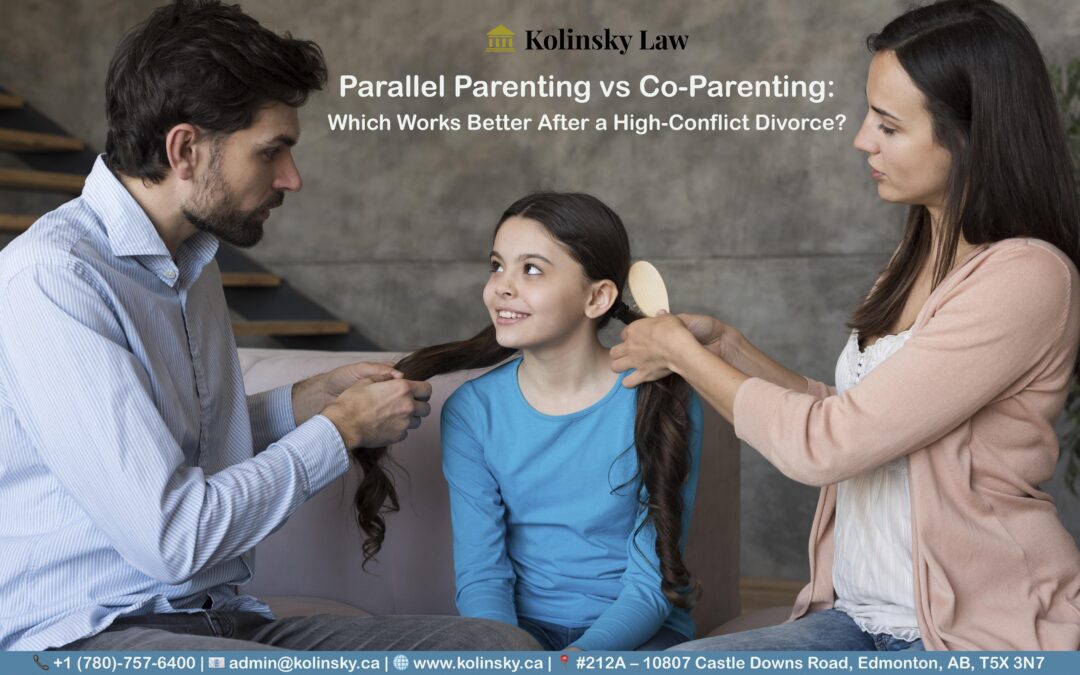
by admin | Oct 17, 2025 | Child Custody Lawyer, Divorce Attorney, Divorce Lawyer, Family Law Lawyer
Understanding Parenting Models After Divorce
When a marriage ends on tense terms, the emotional fallout can be significant for both parents and children. In such cases, managing shared parenting becomes one of the most complex aspects of post-divorce life. The way parents choose to divide responsibilities and communicate after separation can directly affect a child’s emotional and psychological well-being.
Two common parenting frameworks often emerge in these situations: co-parenting and parallel parenting. While both aim to maintain strong relationships between children and each parent, they differ in structure, communication style, and effectiveness—especially when conflict remains high. Understanding these differences is crucial to creating a stable environment for the child.
Struggling to choose a parenting model? Our Family Law Lawyers in Edmonton can help you build a stable, child-focused plan. Schedule your consultation today!
What is Co-Parenting?
Co-parenting requires active communication and collaboration between parents after divorce. Both parents continue to make joint decisions about their child’s education, healthcare, and routines. Ideally, this arrangement promotes consistency and a sense of security for the child. When parents can communicate respectfully, co-parenting can be highly beneficial—children feel supported, experience less stress, and witness positive role modelling.
However, for couples whose relationship remains hostile, co-parenting can become emotionally harmful. Constant disputes and unresolved anger can turn simple conversations into arguments. In our experience as Family Divorce Lawyers in Edmonton, we’ve seen that high-conflict co-parenting often results in children feeling anxious, torn between loyalties, or directly exposed to parental hostility.
Is constant conflict harming your co-parenting efforts? Let our experienced Edmonton Divorce Lawyers guide you toward a healthier solution. Contact us for expert advice.
What is Parallel Parenting?
Parallel parenting takes a different approach. Instead of requiring constant communication, it minimises interaction between parents while maintaining strong, separate relationships with the child. Each parent independently manages their own household rules and routines, limiting the potential for conflict. Communication is typically restricted to essential matters and often handled through written means or parenting apps.
For families where communication consistently breaks down, parallel parenting can provide much-needed peace. Children benefit from reduced tension, and parents can focus on their roles without emotional confrontation. Courts in Alberta often recommend this arrangement when co-parenting is unworkable due to repeated conflict, harassment, or emotional manipulation. Our Edmonton Divorce Lawyers frequently help clients structure clear, court-approved parallel parenting plans that outline schedules, communication boundaries, and responsibilities.
Need a peaceful, structured parenting plan? Our Child Custody Lawyers in Edmonton, Alberta specialise in creating effective parallel parenting agreements. Call us at +1 (780)-757-6400.
Legal and Psychological Considerations
Alberta courts prioritise the best interests of the child and often recommend structured parenting plans when conflict threatens emotional stability. In high-conflict cases, parallel parenting plans clearly outline schedules, decision-making authority, and communication rules to reduce disputes.
From a psychological perspective, children exposed to constant parental conflict face higher risks of anxiety and behavioral issues. Limiting parental interaction through parallel parenting can protect their well-being, while cooperative parents may benefit more from co-parenting, which fosters consistency and emotional security across both homes.
Protect your child’s well-being with a legally sound parenting plan. Consult with the Best Divorce Lawyers in Edmonton, Alberta at Kolinsky Law. Get the clarity you need now!
Choosing What Works Best for Your Family
There is no universal answer to which approach works better. The right choice depends entirely on the parents’ ability to communicate. If both parties can remain respectful and cooperative, co-parenting allows children to thrive with shared decision-making and unity. But if conflict is persistent and communication breaks down, parallel parenting becomes a healthier solution that prioritises peace and emotional safety.
Kolinsky Law assists families in evaluating their circumstances and creating parenting arrangements that protect their children’s well-being. Whether you are at the beginning of a custody dispute or require guidance in establishing a structured parenting plan, our experienced Divorce Attorneys in Edmonton and Child Custody Lawyers in Edmonton, Alberta, provide the legal support and clarity needed throughout the process.
Ready to create a parenting plan that puts your child first? Our Family Law Lawyers in Edmonton are here to support you. Book your consultation online!
How Kolinsky Law Can Help
Every family’s dynamic is unique. That’s why we tailor parenting plans based on the specific emotional, legal, and logistical challenges you face. As one of the Best Divorce Lawyers in Edmonton, Alberta, we provide clear, compassionate, and strategic legal advice to help you transition into post-divorce parenting with confidence.
Our team of Family Law Lawyers in Edmonton focuses on reducing conflict, protecting your parental rights, and ensuring your child’s stability remains at the heart of every decision.
Don’t navigate post-divorce parenting alone. Trust Kolinsky Law, your dedicated Family Divorce Lawyers in Edmonton. Email us at [email protected] to get started.

by admin | Sep 24, 2025 | Blog, Divorce, Divorce and Separation, Divorce Attorney, Divorce Lawyer, Divorce Mediation, Family Divorce Lawyer
Introduction
Family conflicts are often complex, particularly when they involve divorce, child custody, or long-standing disputes between parents. Traditional court processes can be time-consuming, expensive, and emotionally draining, which is why alternative methods of dispute resolution are encouraged. Understanding the comparison of Mediation Vs. Restorative Justice is crucial, as these two approaches are frequently considered in family matters.
While both aim to reduce conflict outside of court, they differ in focus and method. Mediation is designed to help parties reach agreements on practical issues, whereas restorative justice seeks to repair harm and rebuild trust within relationships. Understanding these distinctions is important for families deciding how best to address their conflicts.
Unsure which path is right for your family’s unique situation? Contact our Edmonton Divorce Lawyers today for a confidential consultation to explore your options. Call us at 📞 +1 (780)-757-6400.
What is Mediation?
Mediation is a structured process where a neutral third party facilitates discussions to help people in conflict communicate and find solutions. The mediator does not make decisions but guides both sides toward a mutually acceptable agreement. In family law, mediation is often used to develop parenting plans, set custody schedules, or resolve financial disputes.
It emphasises future arrangements rather than revisiting past issues, giving parents more control and reducing time in court. Mediation is most effective when both parties negotiate in good faith but can be less useful when power imbalances or persistent unwillingness to compromise exist.
Considering mediation to resolve your family dispute? Our skilled mediators at Kolinsky Law can guide you toward a fair and practical agreement. Learn more about our process here: Mediation Services in Edmonton.
What is Restorative Justice?
Restorative justice focuses on addressing harm rather than simply reaching an agreement. It brings together those affected, often parents and sometimes children, to discuss what happened, how each person was impacted, and what can be done to repair the damage.
Guided by a trained facilitator, the process promotes understanding, accountability, and rebuilding trust where relationships have broken down. It is particularly valuable when emotional harm or resentment prevents families from moving forward. Unlike mediation, restorative justice does not always result in a formal agreement but aims to reshape relationships, creating a stronger foundation for cooperation in the future.
Is emotional healing needed for your family to move forward? Discuss the potential of restorative justice with our compassionate team. We help families in Edmonton rebuild trust. Schedule a conversation today.
Comparing the Two Approaches
Although mediation and restorative justice share the goal of reducing conflict outside of court, their methods and outcomes differ significantly.
- Focus: Mediation is primarily solution-driven, while restorative justice is relationship-driven.
- Timeframe: Mediation concentrates on current and future issues, while restorative justice looks backward to address past harms.
- Outcome: Mediation often results in written agreements, whereas restorative justice may produce commitments that are more personal or emotional in nature.
- Suitability: Mediation is generally best for families seeking quick, practical resolutions. Restorative justice works better when unresolved emotional issues are preventing constructive dialogue.
Both methods require the willingness of participants to engage honestly. If one party is uncooperative or abusive, the court may need to step in.
Need clarity on whether mediation or restorative justice suits your conflict? Our experienced Family Divorce Lawyer Edmonton can provide a clear, professional assessment. Call us help you choose the right path – 📞 +1 (780)-757-6400.
Choosing the Right Process
Deciding between mediation and restorative justice depends on the nature of the conflict. For disputes focused on custody schedules or property division, mediation is often the most efficient choice. For conflicts rooted in long-standing resentment or broken trust, restorative justice may provide the emotional repair needed before practical agreements can succeed.
Families in Edmonton who are uncertain about the right approach often consult legal professionals. An experienced Divorce Attorney in Edmonton can explain how each process fits within Alberta’s family law framework and advise on which option may offer the best results for a given situation.
Ready to resolve your family conflict with clarity and confidence? Visit our office at #212A – 10807 Castle Downs Road, Edmonton, AB, T5X 3N7 or message us online to book an appointment with a leading Divorce Lawyer in Edmonton.
Conclusion
Restorative justice and mediation both provide valuable alternatives to courtroom battles in family conflicts. Mediation is effective for reaching structured, enforceable agreements on immediate issues, while restorative justice focuses on repairing relationships and fostering long-term cooperation.
Neither method is universally “better.” The right choice depends on the family’s circumstances, the nature of the conflict, and the desired outcomes. By carefully evaluating their situation and seeking legal guidance when necessary, families can select the process that best supports their needs and protects the well-being of their children.
Don’t navigate this difficult decision alone. Contact Kolinsky Law, your trusted Divorce Attorney Edmonton, for expert guidance. Call +1 (780)-757-6400 or find us on Google My Business.
About David Kolinsky – Best Divorce Lawyers in Edmonton Alberta
At Kolinsky Law, we understand that family conflicts are more than just legal issues—they are deeply personal matters that affect your future and your children’s well-being. David Kolinsky, a leading Divorce Lawyer in Edmonton, brings a compassionate yet strategic approach to every case. With extensive experience in both mediation and collaborative law, he is dedicated to helping Alberta families find respectful, out-of-court solutions that preserve relationships and protect your interests. If you seek a resolution that prioritises your family’s peace and stability, trust David Kolinsky and our team to provide the expert guidance and support you deserve.
#FamilyLaw #EdmontonLawyer #Divorce #RestorativeJustice #Mediation #ConflictResolution #CoParenting #AlbertaDivorce #HealthyDivorce #ChildCustody #FamilyLawyer #Edmonton #KolinskyLaw #DivorceLawyer #AlternativeDisputeResolution

by admin | Aug 22, 2025 | Blog, Divorce, Divorce and Separation, Divorce Attorney, Divorce Lawyer
Divorce is both a legal and personal turning point, and one of the first questions many people ask is, “How Long Does Divorce Take in Alberta?” The answer is not the same for everyone, because timelines depend on factors such as separation requirements, whether the divorce is contested or uncontested, and how quickly the courts process applications.
Some divorces are resolved within a few months, while others may extend to a year or more. Understanding the typical timelines and the reasons delays occur can help you prepare, set realistic expectations, and make informed decisions about your next steps.
Get a personalised timeline estimate for your situation. Book a Consultation with our Edmonton Divorce Lawyers.
Starting Point: Separation Requirements
In Alberta, your divorce timeline begins with separation. Under the Divorce Act, you must live separately and apart for at least one year before the divorce can be finalised. Exceptions exist if you file on the grounds of adultery or cruelty, but most divorces proceed based on the one-year separation. You can start the application during that year, but the judge will not grant a final judgment until the period is complete.
Uncontested and Joint Divorce Options
Divorces move quickest when you and your spouse reach agreement on all matters, including parenting, support, and property. A joint divorce, where both spouses apply together, can sometimes be completed in two to three months if the paperwork is accurate and there are no delays. An uncontested divorce, where one spouse files and the other does not oppose, often takes three to four months. In practice, even these cases may stretch to six months or longer due to court workloads.
Pursuing an uncontested divorce? We ensure your paperwork is flawless to avoid delays. Let Us Handle Your Filing.
Common Reasons for Delays
Delays can arise if divorce papers are served outside Alberta or if children are involved. The court must also obtain a Clearance Certificate from the Divorce Registry, which may take six weeks or more. After the judge signs the Divorce Judgment, there is a thirty-one-day waiting period, and court backlogs may further prolong the process.
Contested Divorces Take Longer
If you and your spouse are unable to reach an agreement on parenting, support, or the division of property, the divorce is treated as contested. These cases often require multiple hearings, mediation, and sometimes a trial. As a result, the process often takes a year or longer to conclude. The complexity of the issues, the amount of evidence required, and the level of conflict between spouses all influence the length of time involved.
Facing a contested divorce? You need a strategic advocate. Build a strong case with our experienced team.
Risks of Extended Delays
Beyond the normal waiting periods, Alberta courts may dismiss a family law case if there is no progress for three years. This rule prevents files from sitting indefinitely without action. If your case risks dismissal, you may need to show valid reasons for the delay or request the court’s permission to continue. Taking consistent steps and moving the case forward helps avoid this risk.
Typical Timelines at a Glance
A joint divorce is usually completed within two to three months, while an uncontested divorce often takes three to four months. In reality, uncontested cases may extend to six to eight months or longer because of court delays. Contested divorces tend to be more complicated and can take a year or longer to finalise. These timelines apply when separation rules are met and documents are filed correctly.
How We Can Support You
Even straightforward divorces involve legal requirements and strict timelines. At Kolinsky Law, we assist clients with accurate documents, timely filings, and strategies to avoid delays. Whether you are pursuing a joint divorce or managing a contested case, our team protects your rights and ensures steady progress.
With guidance from an experienced Divorce Attorney in Edmonton and trusted Family Divorce Lawyers in Edmonton, you can move through the process confidently while keeping your family’s best interests a priority.
Don’t navigate complex timelines alone. Schedule a strategy session with our Edmonton family lawyers today.
About the Law Firm – Kolinsky Law
Kolinsky Law is a respected Edmonton family law firm dedicated to providing clear, compassionate, and strategic legal guidance through all aspects of divorce and separation. Our approach is client-focused, ensuring you understand every step of the process, from initial filing to final judgment. We pride ourselves on efficient case management to help avoid unnecessary delays and achieve resolutions that protect your future and your family’s well-being. Our expertise covers uncontested and joint divorces, complex contested cases, and all related matters including parenting, support, and property division.
Ready to move forward with your divorce? Contact Kolinsky Law, a Best Divorce Lawyer in Edmonton, for a consultation.
Phone: +1 (780)-757-6400
Email: [email protected]
Visit our Google My Business page to read reviews from clients we’ve helped: Kolinsky Law Reviews
